You can outsource tasks to virtual assistants when the work is repeatable, process-driven and does not require your physical presence. The rule of thumb: if a task follows a documented process and doesn’t need your physical presence, it can be delegated.
The easiest way to decide what to outsource first is to look at the work that repeatedly interrupts your day rather than the work that merely takes the longest.
Run your task list through three questions: Is it repeatable? Can it be documented? Does it require physical presence?
A task that happens daily, weekly or whenever a predictable trigger occurs is a strong candidate. So is a task that can be explained through a short standard operating procedure, checklist or screen recording. Finally, if the work can be completed inside a browser, CRM, accounting platform or other cloud-based system, it is usually suitable for remote delegation.
The principle is simple: if someone else can follow the process without needing your constant judgement, you probably don’t need to keep doing it yourself.
The complete list of tasks to outsource to a VA
Virtual assistants can take on far more than traditional administrative work. The most useful roles often sit at the intersection of routine operations, customer service, finance and marketing.
Admin & scheduling
Administrative work has a peculiar way of consuming a working day. An email here, a calendar change there and another spreadsheet to update can leave a business owner busy without necessarily moving the business forward.
Inbox triage and management is one of the easiest places to begin. A VA can filter unwanted messages, organise incoming mail, flag urgent correspondence, unsubscribe from unnecessary lists and draft routine replies using approved templates.
Calendar management is another natural fit. A VA can arrange meetings, resolve scheduling conflicts, send reminders, protect blocks of uninterrupted working time and build sensible buffers between appointments. Instead of constantly negotiating your own availability, you can concentrate on the meetings that actually require you.
Travel coordination can also be delegated. A VA can research flights and hotels, compare options, arrange ground transportation and assemble an itinerary in one place.
Then there is data entry and file organisation: updating spreadsheets, sorting digital folders, maintaining databases, transferring notes into project-management systems and keeping shared documents orderly.
These tasks may seem minor individually. Collectively, they create the operational clutter that makes delegation worthwhile.
Finance & Bookkeeping
Financial administration is another area where a VA can remove considerable routine work, provided appropriate oversight remains in place.
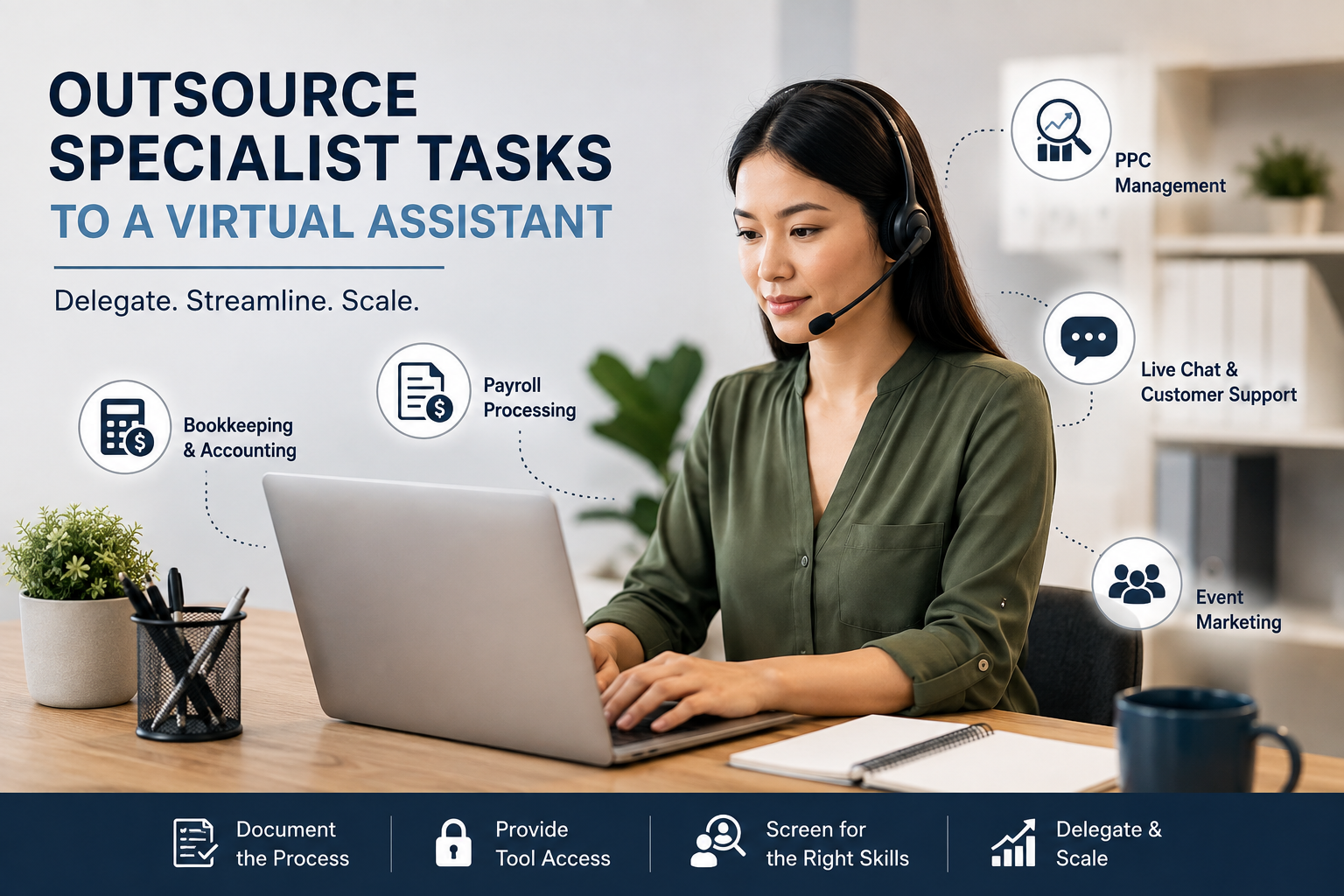
A VA can prepare invoices and accounts-receivable records, monitor payment status and send approved reminders when invoices become overdue. They can also handle expense tracking, categorising transactions, matching receipts with statements and maintaining digital records.
For businesses that use contractors, a VA can help with payroll preparation, such as collecting approved hours from time-tracking systems and staging information for final review.
Bank reconciliation can similarly be prepared by matching transactions in bank and credit-card statements against accounting records.
The important distinction is between administrative financial work and regulated financial responsibility. A VA can help keep the books organised, but final approvals and professional accounting or tax decisions may require a qualified professional.
Customer & Sales Support
Customer service is often an excellent candidate for outsourcing because customers expect prompt responses even when the business owner is busy elsewhere.
A VA can manage live-chat enquiries and help-desk tickets, answer routine questions, provide order-status information and escalate technical or unusual cases to the appropriate person.
They can also maintain CRM records, ensuring that contact information, lead status, notes and follow-up dates remain current. For sales teams, this basic hygiene can make a substantial difference: a neglected CRM quickly becomes an unreliable one.
Lead research and prospecting support can also be delegated, including gathering publicly available business information and preparing records for the sales team.
Then there are follow-ups. A VA can organise approved email sequences, confirm appointments and keep track of prospects who need another response. The aim is not to replace the salesperson’s judgement, but to ensure that promising conversations do not disappear into an overloaded inbox.
Marketing
Marketing departments are filled with creative work. However, they also contain a certain amount of administration.
Social media scheduling is a straightforward example. Once captions and visual assets have been approved, a VA can load them into scheduling platforms and maintain the publishing calendar across different accounts.
A VA can also assist with PPC campaign administration, such as monitoring budgets, collecting performance figures, organising keyword data and maintaining reporting spreadsheets. Strategic decisions about campaigns should remain with the appropriate marketing professional.
For businesses running webinars, conferences or other campaigns, event marketing coordination can include managing registrations, organising digital materials, preparing attendee lists and sending approved follow-up communications.
The dividing line is useful: delegate the machinery around marketing while retaining ownership of the message, positioning and strategic decisions.
Benefits of Outsourcing to a Virtual Assistant
The benefits of outsourcing extend beyond simply getting a few tasks off your desk.
The first is time. Routine administration can consume hours that would otherwise be spent on sales, product development, client relationships or strategic planning. Delegation creates room for work that depends on the business owner’s judgement and experience.
There is also a potential cost advantage. A virtual assistant can provide support without the same fixed overhead associated with a traditional full-time employee, including office space and equipment. The exact economics depend on the arrangement, location, hours and level of expertise required.
Flexibility is another advantage. Businesses rarely need exactly the same amount of administrative support every week. Outsourcing can make it easier to increase or reduce support as demand changes.
Finally, outsourcing can provide access to specialised skills. Experienced VAs may already be familiar with CRM platforms, project-management tools, accounting software, scheduling systems and digital workflows, reducing the time needed to bring them up to speed.
What Not to Outsource
Good delegation requires knowing where to draw the line.
Keep core business strategy and vision in-house, including major changes to your business model, pricing strategy, market positioning and product direction. These decisions depend on context that cannot always be captured in an SOP.
Tasks involving licensed professional judgement or legal and financial sign-off should remain with appropriately qualified people. The same applies to high-stakes negotiations involving investors, senior hires or major contracts.
And some work simply requires a person to be there. Physical inspections, inventory counts, local deposits and other on-site responsibilities cannot be turned into remote tasks merely because a business wants to save time.
How to Start Outsourcing
The safest way to begin is with one small, repeatable responsibility rather than handing over an entire department.
Choose a task you perform frequently, document how you do it, define what success looks like and establish a simple review process. Once the workflow is working smoothly, add another responsibility.
For businesses looking for a managed option, SourceU offers pre-vetted remote virtual assistants starting at $19 a day, with support that can be matched to the tools and processes a business already uses. You can explore its virtual assistant marketplace or learn more about hiring a virtual assistant for small-business needs.
FAQs
What tasks should I outsource to a virtual assistant first?
Start with low-risk, high-frequency tasks that consume time without requiring your personal judgement. Inbox triage, calendar management, routine data entry, basic customer-support tickets and scheduling are usually strong starting points.
What are the benefits of outsourcing administrative tasks to a VA?
Outsourcing administrative work can free business owners from repetitive tasks, reduce some staffing overhead and create more time for revenue-generating and strategic work. It can also provide flexible access to people with experience in specific software and workflows.
What should you never outsource to a virtual assistant?
Do not delegate core business strategy, final legal or regulated financial sign-offs, highly sensitive negotiations or work that requires physical presence. A VA can support these functions administratively, but responsibility for high-stakes decisions should remain with the appropriate person.
How much does it cost to outsource tasks to a VA?
The cost varies according to location, experience, working hours and the complexity of the work. Through managed platforms such as SourceU, offshore administrative support can start at $19 per day, while specialised onshore or technical virtual assistants can cost substantially more. The right comparison is not simply hourly rate, but the value of the time and capacity the VA returns to the business.