How to Outsource Specialist Tasks to a Virtual Assistant (PPC, Bookkeeping, Chat & More)
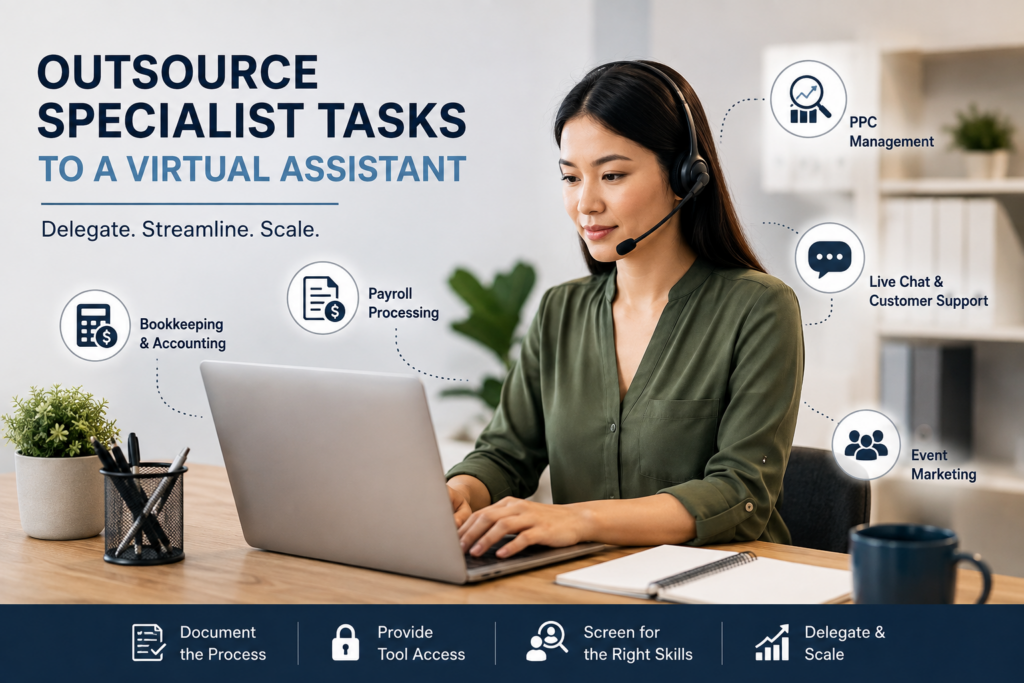
Specialist tasks such as PPC management, payroll processing, bookkeeping and live chat can be outsourced to a virtual assistant. The key is to document the process, provide appropriate tool access and screen for the specific skills required before handing it over. Can You Outsource Specialist Work to a VA? The short answer is yes, but specialist does not necessarily mean strategic. A virtual assistant can take responsibility for many functions that once seemed too specialised to delegate. The distinction is between doing the work within an established system and making the high-stakes decisions that determine the direction of the business. A VA with the right experience can manage routine PPC administration, prepare payroll information, maintain bookkeeping records, respond to customer enquiries or coordinate an event marketing campaign. What they should not automatically inherit is the authority to change financial controls, make major advertising decisions or approve sensitive transactions. The safest approach is to break a specialist function into its component parts. Identify what can be standardised, document the workflow, define the VA’s authority and establish a review process. The more clearly those boundaries are drawn, the easier it becomes to delegate without losing control. Outsourcing PPC Campaign Administration to a VA If you are learning how to outsource PPC campaigns to virtual assistants, start with administration rather than strategy. A trained VA can monitor campaign dashboards, record daily or weekly spend, organise keyword and performance data, prepare reports and flag significant changes for review. They can also maintain spreadsheets and ensure that campaign information remains organised across platforms. Before handing over access, document your account structure, reporting schedule, spending limits and escalation rules. Make clear which changes require approval. The VA can keep the machinery moving; the person responsible for marketing strategy should remain in charge of targeting, positioning, creative direction and major budget decisions. Outsourcing Payroll Processing to a VA Payroll is another function where administrative support can be valuable, but accuracy and confidentiality are essential. A VA can collect approved hours, organise contractor records, prepare payroll information and check that required documentation is present. They may also help maintain recurring payroll schedules. If you outsource payroll processing, establish a clear approval process. The VA should know what information they can enter, what they can amend and what requires final approval from an authorised person or payroll professional. Because payroll rules vary by jurisdiction, businesses should also ensure that any regulated calculations, filings or compliance decisions are handled by appropriately qualified professionals. Outsourcing Bookkeeping to a VA Bookkeeping is often well suited to structured delegation because much of the work involves recurring transactions and record-keeping. A VA can categorise transactions, organise receipts, enter invoices, track expenses and prepare records for reconciliation. They can also keep digital financial documentation orderly and up to date. When outsourcing bookkeeping to virtual assistants, provide a chart of accounts, naming conventions, reconciliation procedures and clear instructions for unusual transactions. Regular reviews can catch mistakes before they become larger problems. As with payroll, administrative bookkeeping should be distinguished from professional accounting, tax advice and regulated financial sign-off. Outsourcing Live Chat and Customer Support Customer conversations are often time-sensitive, making outsourcing chat to virtual assistants an attractive option for growing businesses. A VA can answer frequently asked questions, provide order information, collect basic customer details and route technical or unusual issues to the appropriate team member. The best starting point is a knowledge base containing approved answers, escalation rules and examples of situations that require human intervention. Give the VA a clear sense of the company’s tone as well as the boundaries of what they can promise customers. The goal is not simply faster replies. It is a consistent, useful reply. Outsourcing Event Marketing Coordination Events generate a long list of administrative jobs before, during and after the event. A VA can manage registrations, update attendee lists, send approved invitations and reminders, organise digital materials and coordinate post-event follow-ups. They can also maintain spreadsheets and make sure deadlines are visible to everyone involved. For how to outsource event marketing to virtual assistants, begin by creating a timeline that assigns every recurring task to a specific person. Once the process is documented, much of the coordination can happen remotely. The marketing team can then concentrate on the event’s message, audience and creative direction rather than chasing every RSVP. How to Screen for Specialist Skills Before Hiring The mistake businesses make when outsourcing specialist work is hiring for the title rather than the actual task. Start by defining the function precisely. Instead of looking for a VA who is simply “good at marketing”, specify that you need someone experienced with PPC reporting, campaign administration or a particular advertising platform. Ask candidates about the software they have used and the type of work they have performed with it. For specialist roles, a practical test can be more revealing than a list of claimed skills. Give the candidate a small, fictional task and assess how they approach it. References, previous work samples and relevant certifications can provide additional evidence, but they should not replace a clear onboarding process. Finally, consider using a trial period with limited permissions. Good delegation is built on evidence and gradually expanded responsibility, not blind trust. Frequently Asked Questions Can a Virtual Assistant Do Bookkeeping? Yes. A suitably trained VA can handle routine bookkeeping tasks such as transaction categorisation, receipt management, invoice entry and financial record organisation. Professional accounting, tax advice and regulated sign-offs may require a qualified professional. Can a Virtual Assistant Run PPC Campaigns? A VA can manage many PPC administrative tasks, including reporting, budget monitoring and campaign data organisation. More consequential decisions, such as major budget changes or overall advertising strategy, should remain with the person responsible for the campaign. Can a Virtual Assistant Handle Payroll? A trained VA can assist with payroll administration, including collecting hours, organising records and preparing information for processing. Businesses should retain appropriate oversight of payroll approvals and ensure that regulated or jurisdiction-specific compliance work is handled
Delegate Calendar Management to a Virtual Assistant: A Simple Guide

To delegate calendar management to a virtual assistant, give them controlled access to your calendar, agree on booking rules and buffer times, and let them own scheduling end to end. This frees you from the back-and-forth of every meeting request and gives your working day a clearer structure. Why Calendar and Time Management Is the First Thing to Delegate For many founders, executives and business owners, the calendar is less a planning tool than a constant source of interruption. Meeting requests arrive throughout the day, appointments move, conflicts appear and seemingly minor scheduling decisions accumulate. That makes calendar management one of the easiest CEO virtual assistant tasks to delegate. The work is repetitive, highly structured and usually carried out entirely online. More importantly, the rules governing your calendar can be documented. A virtual assistant does not need to know everything about your business to know that meetings should not be booked during your daily focus period, that two calls need a 15-minute buffer between them or that certain appointments take priority. Delegating these decisions can turn time management from a daily chore into a managed system. The objective is not simply to give someone access to your calendar. It is to give them responsibility for maintaining it according to rules you establish. How to Hand Over Your Calendar Safely The first step is to decide exactly what your VA needs to see and change. Use the lowest level of access that allows them to do the job effectively, and review the permissions offered by your calendar platform before granting access. Then establish your booking rules. These should answer practical questions such as: You can turn these rules into a short scheduling guide or standard operating procedure. A screen recording can also be useful for showing your VA how you currently handle common situations. Start with a limited handover if you are concerned about giving up control. Let the VA manage routine appointments first, then expand their responsibility once the process is working smoothly. The key to safe delegation is clarity. Your VA should not have to guess what you mean by “urgent”, “important” or “too busy”. Define those terms. What a VA Manages Day to Day Once the system is established, a VA can manage much of the routine work surrounding your calendar. Scheduling and rescheduling are the obvious starting points. The VA can coordinate availability with clients and colleagues, send invitations, move appointments and confirm changes without involving you in every email. They can also maintain buffer times between meetings. This is particularly useful for people whose calendars have become packed with consecutive calls. A 30-minute meeting may technically require only half an hour, but the transition between meetings, preparation and follow-up still consume time. A VA can therefore help protect realistic gaps in the day. Reminders and confirmations are another useful responsibility. They can ensure that participants receive the necessary information before a meeting and follow up when confirmation is required. Then there is conflict resolution. When two appointments overlap, the VA can apply the priority rules you have established, identify alternatives and resolve the issue before it reaches your desk. A good VA can also periodically review the calendar itself. Recurring meetings that are no longer necessary, poorly timed appointments and unnecessary commitments can be flagged for your attention. In this sense, calendar management becomes more than an appointment setting. It becomes a form of delegation time management: someone else helps ensure that your limited working hours are being used deliberately. For Founders and CEOs: Protect Your Deep-Work Time For founders and CEOs, the greatest benefit may not be the meetings VA schedules but the meetings they prevent from consuming the day. Strategic work requires uninterrupted attention. Product development, financial planning, writing, hiring and major business decisions are difficult to fit into the gaps between calls. A VA can therefore treat deep-work time as a protected commitment rather than empty space. For example, you might establish two hours each morning as meeting-free time. The VA then works around that block when scheduling appointments. You might also reserve specific afternoons for external meetings while keeping other periods for internal work. This creates a simple hierarchy: not every available hour is bookable. The same principle applies outside the calendar. A VA can help organise reminders, prioritise follow-ups and maintain a manageable schedule, allowing you to spend less time coordinating your time. If you are exploring other ways to outsource tasks to a virtual assistant, calendar management is a practical place to begin because the process is easy to define and measure. Frequently Asked Questions How Do I Give a Virtual Assistant Access to My Calendar? Give the VA the appropriate level of delegated or shared-calendar access through your calendar platform. Before doing so, define their responsibilities, booking rules, working hours, privacy requirements and approval limits. Use the minimum permissions necessary for the role. What Can a Virtual Assistant Do With My Calendar? A VA can schedule and reschedule meetings, coordinate availability, send invitations and reminders, maintain buffers, resolve routine conflicts and help protect blocks of focused work. The exact responsibilities should be agreed in advance.
Outsource Tasks to Virtual Assistants : Guide for When and How

You can outsource tasks to virtual assistants when the work is repeatable, process-driven and does not require your physical presence. The rule of thumb: if a task follows a documented process and doesn’t need your physical presence, it can be delegated. The easiest way to decide what to outsource first is to look at the work that repeatedly interrupts your day rather than the work that merely takes the longest. Run your task list through three questions: Is it repeatable? Can it be documented? Does it require physical presence? A task that happens daily, weekly or whenever a predictable trigger occurs is a strong candidate. So is a task that can be explained through a short standard operating procedure, checklist or screen recording. Finally, if the work can be completed inside a browser, CRM, accounting platform or other cloud-based system, it is usually suitable for remote delegation. The principle is simple: if someone else can follow the process without needing your constant judgement, you probably don’t need to keep doing it yourself. The complete list of tasks to outsource to a VA Virtual assistants can take on far more than traditional administrative work. The most useful roles often sit at the intersection of routine operations, customer service, finance and marketing. Admin & scheduling Administrative work has a peculiar way of consuming a working day. An email here, a calendar change there and another spreadsheet to update can leave a business owner busy without necessarily moving the business forward. Inbox triage and management is one of the easiest places to begin. A VA can filter unwanted messages, organise incoming mail, flag urgent correspondence, unsubscribe from unnecessary lists and draft routine replies using approved templates. Calendar management is another natural fit. A VA can arrange meetings, resolve scheduling conflicts, send reminders, protect blocks of uninterrupted working time and build sensible buffers between appointments. Instead of constantly negotiating your own availability, you can concentrate on the meetings that actually require you. Travel coordination can also be delegated. A VA can research flights and hotels, compare options, arrange ground transportation and assemble an itinerary in one place. Then there is data entry and file organisation: updating spreadsheets, sorting digital folders, maintaining databases, transferring notes into project-management systems and keeping shared documents orderly. These tasks may seem minor individually. Collectively, they create the operational clutter that makes delegation worthwhile. Finance & Bookkeeping Financial administration is another area where a VA can remove considerable routine work, provided appropriate oversight remains in place. A VA can prepare invoices and accounts-receivable records, monitor payment status and send approved reminders when invoices become overdue. They can also handle expense tracking, categorising transactions, matching receipts with statements and maintaining digital records. For businesses that use contractors, a VA can help with payroll preparation, such as collecting approved hours from time-tracking systems and staging information for final review. Bank reconciliation can similarly be prepared by matching transactions in bank and credit-card statements against accounting records. The important distinction is between administrative financial work and regulated financial responsibility. A VA can help keep the books organised, but final approvals and professional accounting or tax decisions may require a qualified professional. Customer & Sales Support Customer service is often an excellent candidate for outsourcing because customers expect prompt responses even when the business owner is busy elsewhere. A VA can manage live-chat enquiries and help-desk tickets, answer routine questions, provide order-status information and escalate technical or unusual cases to the appropriate person. They can also maintain CRM records, ensuring that contact information, lead status, notes and follow-up dates remain current. For sales teams, this basic hygiene can make a substantial difference: a neglected CRM quickly becomes an unreliable one. Lead research and prospecting support can also be delegated, including gathering publicly available business information and preparing records for the sales team. Then there are follow-ups. A VA can organise approved email sequences, confirm appointments and keep track of prospects who need another response. The aim is not to replace the salesperson’s judgement, but to ensure that promising conversations do not disappear into an overloaded inbox. Marketing Marketing departments are filled with creative work. However, they also contain a certain amount of administration. Social media scheduling is a straightforward example. Once captions and visual assets have been approved, a VA can load them into scheduling platforms and maintain the publishing calendar across different accounts. A VA can also assist with PPC campaign administration, such as monitoring budgets, collecting performance figures, organising keyword data and maintaining reporting spreadsheets. Strategic decisions about campaigns should remain with the appropriate marketing professional. For businesses running webinars, conferences or other campaigns, event marketing coordination can include managing registrations, organising digital materials, preparing attendee lists and sending approved follow-up communications. The dividing line is useful: delegate the machinery around marketing while retaining ownership of the message, positioning and strategic decisions. Benefits of Outsourcing to a Virtual Assistant The benefits of outsourcing extend beyond simply getting a few tasks off your desk. The first is time. Routine administration can consume hours that would otherwise be spent on sales, product development, client relationships or strategic planning. Delegation creates room for work that depends on the business owner’s judgement and experience. There is also a potential cost advantage. A virtual assistant can provide support without the same fixed overhead associated with a traditional full-time employee, including office space and equipment. The exact economics depend on the arrangement, location, hours and level of expertise required. Flexibility is another advantage. Businesses rarely need exactly the same amount of administrative support every week. Outsourcing can make it easier to increase or reduce support as demand changes. Finally, outsourcing can provide access to specialised skills. Experienced VAs may already be familiar with CRM platforms, project-management tools, accounting software, scheduling systems and digital workflows, reducing the time needed to bring them up to speed. What Not to Outsource Good delegation requires knowing where to draw the line. Keep core business strategy and vision in-house, including major changes